
Part six of a ten part blog series “Sitting in the Chair” reflections, reality and insights of chairing a board.
Same title, same table, different job: why who you serve should shape how your board leads
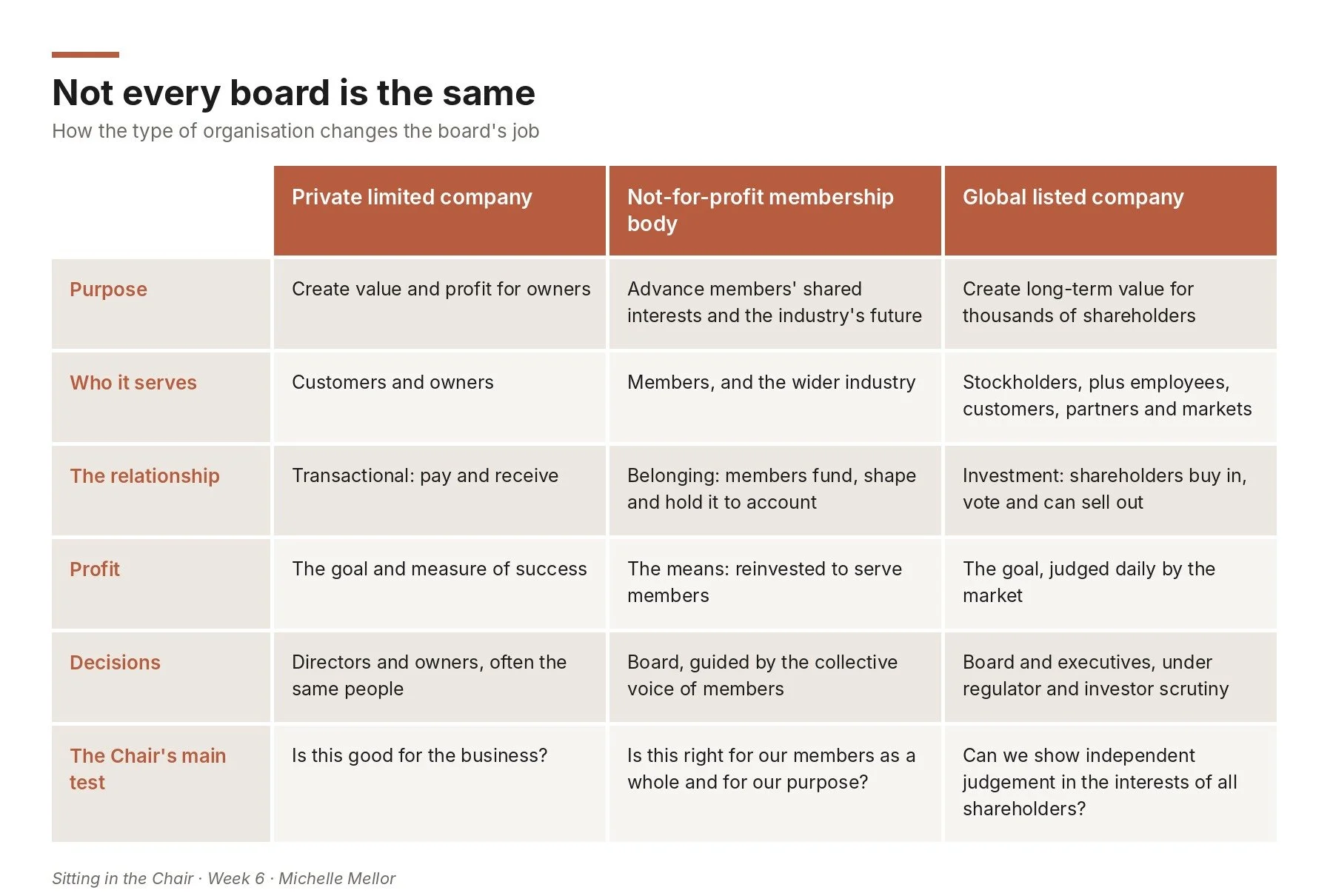
When people talk about "the board, they often picture one thing: a table, a Chair, some directors and a set of papers. But the job of a board, and of the person who chairs it, depends on what kind of organisation it serves.
I've sat on both sides of this. For more than 35 years I've been a director of the business Richard and I started and subsequently many other bsuinesses. I also spent nine years on the board of the REC, the Recruitment and Employment Confederation: six as a non-executive director and three as Chair. The same governance words appear in both worlds (strategy, risk, accountability) but they mean different things.
A member-led, not-for-profit organisation isn't simply a private company without shareholders. It exists for a different purpose, answers to different people and often has to balance competing member interests. If you step into the Chair without understanding that, you can make decisions that are sound in business terms and still wrong for the organisation.
Boards come in many forms: private and family companies, listed companies, trade associations and membership bodies, charities, social enterprises and community interest companies, co-operatives and mutuals, public bodies, NHS trusts, school and academy trust boards, and voluntary boards such as sports clubs. Each has a different purpose and a different set of people it answers to. In this post I'll look closely at three of them..
The limited company: purpose through profit
A private limited company exists to create value for its owners. It does that by selling products or services to customers, and profit is the measure of success. Directors are expected to promote the success of the company for the benefit of its shareholders, while taking account of employees, customers, suppliers and the wider community.
The relationship with customers is a commercial exchange: they pay and you deliver. If they're unhappy, they leave. Decisions sit with the directors and owners, and the lines of accountability are fairly clear. In a small owner-managed business like ours, the people making the decisions are often the people carrying the risk.
That clarity is a gift. You can move quickly, back your judgement and change direction when the market changes, because the people you answer to are usually in the room.
The not-for-profit membership body: profit with a purpose
Photo credit New York Said
A trade association or membership body exists to advance the shared interests of its members and the industry they work in. It is their collective voice to government, regulators and the media. It supports members with advice, training, legal guidance and connections, and keeps them informed as regulation and markets shift.
It also has to look ahead. A good membership body anticipates trends, technology and regulatory change, so its members are ready for what's coming and the industry stays sustainable for the future.
Profit still matters. Without it there's no investment, no resilience and no future. But it is profit with a purpose: any surplus goes back into the organisation to meet members' needs, now and in the years ahead.
The biggest difference is the relationship. Members aren't just customers who buy a service. They pay to belong, they shape the organisation's priorities and they hold its leadership to account. Decisions are more democratic, guided by the collective interest rather than any one voice. And members rarely agree on everything: large and small firms, different sectors and different regions can all want different things.
A third kind of board: the global listed company
Photo credit KOBU Agency
This week's news from NVIDIA shows a different board again. On 12 November, NVIDIA announced that founder Jensen Huang had resigned as President, CEO and director. The finance director, Colette Kress, stepped in as interim CEO, and long-serving director Harvey Jones was appointed the company's first-ever Chair of the Board. Eleven days later, the board voted unanimously to reinstate Huang, saying it was satisfied with his candour and his ability to lead.
I'm not going to comment on the circumstances. That's for the board and the investigations it has said will run their course. But the board's own announcements show what governance looks like in a company of that scale. It formed a committee made up only of independent directors, with independent lawyers, to look into reports that Huang had been the target of a foreign intelligence effort. It set up a second committee of independent directors to oversee national security and export controls. And it is recruiting a Chief Compliance Officer who will report to a board committee, not to management.
A listed company answers to stockholders it will never meet, to regulators, to the markets and, in NVIDIA's case, to governments. Founder-led companies add another layer: when one person is so closely tied to the organisation's success, the board has to be visibly independent of them, especially when it matters most. Here in the UK, listed companies are expected to keep the Chair and CEO roles separate for exactly that reason. It is striking that NVIDIA had no Chair of the Board until this month.
What changes when you're in the Chair

Photo credit Allec Gomes
Moving from my own business into the REC boardroom, I had to adjust how I thought about decisions. In our company, a good decision was one that made the business stronger. At the REC, a good decision had to be right for a broad membership with different needs, for the integrity of the organisation and for the industry's future, all at once.Three things stood out for me:You serve the whole membership, not the loudest voice. Some members will feel strongly and speak up often. The Chair's job is to make sure the board hears everyone, including the members who never come to a meeting.
Purpose is the tiebreaker. When interests compete, and they will, the question is not "who wins?" but "what serves our purpose and our members as a whole?"
Sustainability is a duty, not a target. A membership body has to stay financially strong so it can still be there for members in ten years' time. That means saying no to some things that would be popular today.
None of this makes one type of board better than the other. They're different, and the best Chairs adapt their approach to fit the organisation they serve.
Should governance run the same, whatever the board?
Yes and no. The principles don't change. Every board, whether it serves a family business, a trade association or a global company, needs:
clarity about who it serves and why it exists
independence of mind, so it can challenge the executive, including a founder
a Chair and CEO with clear roles and enough distance to hold each other to account
integrity and openness, especially when things go wrong
a long-term view of the organisation's sustainability
What changes is how those principles are applied. In a small company, independence might mean an adviser or non-executive who will tell the owners what they don't want to hear. In a membership body, it means protecting the collective interest from any single group of members. In a listed company, it means formal committees, independent advice and public disclosure.
The structure should fit the organisation. The governance standards should not bend to fit anyone.
The question for the board table

Who are we here to serve, and how should that shape every decision we make?
If your board can answer that clearly, and agrees on the answer, you have a strong foundation for everything else.
Next week
I'll draw on my time chairing a trade association to explore what it really means to act in the collective interest of members, protect the organisation's purpose, behave ethically and stay financially sustainable, all at the same time. Because not-for-profit doesn't mean not-for-purpose.
Would love to hear your board experience… want to continue the discussion, reach out on michellemellor.com or Linked In
Sources:

 NVIDIA Announces CEO Transition (SEC Form 8-K, 12 November 2026)

 NVIDIA Board Reinstates Jensen Huang as President, CEO and Board Director (23 November 2026)