
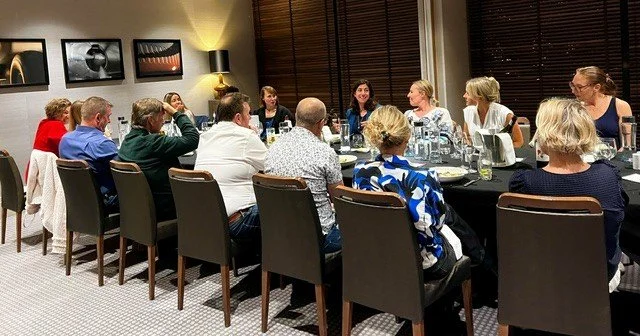
Part two of “Sitting in the Chair” - the people around the table.
Look around your board table and ask yourself one question. If you were recruiting your board today, for the strategy you've just agreed, would you choose the same people?
If you hesitated, that hesitation is the gap between the board you have and the board you need.
Every board has one. Nobody sets out to build the wrong board. People join a board for good reasons, with the right skills for the time. Good governance means their terms are set out in the articles of association, giving the board stability and continuity.
But the world outside moves far faster than any term of office, and the skills an organisation needs can change long before a term comes to an end. Boards tend to reflect the organisation as it was when their members joined. The board you need is the one that can take the organisation to where it's going next.
When I became Chair, I took on a board that had served the organisation well. Its composition, committees and ways of working had been shaped by my predecessor and by colleagues who cared deeply about the REC. I'd sat around that table for six years as a non-executive director alongside my collegues, so I knew it well, and I came into the role with a good sense of what we might need next. But it was only once I was in the Chair, and when we had agreed where the organisation was heading, that the picture became truly clear. A board looks different from the Chair than it does from any other seat around the table.
Here's the approach I took, in four stages.
1. See the gap - Start with the strategy, not the pople.
In my first few months, we confirmed a new five year strategy. Only then could I ask the honest question: do we have the board to deliver it?
To answer it, I commissioned a skills audit and a board evaluation, so we as a board could see clearly what and who we had in relation to what and who we needed.
Some gaps were obvious. AI and technology was a huge one, opening up fast. Finance was another, because a board member with that expertise had recently stepped down. Others weren't gaps yet but soon would be. I could see people strategy, particularly leadership development, becoming increasingly important.
A good Chair encorages the board not to only fill today's gaps, they look ahead to tomorrow's.
2. Close the gap - always be recruiting, not just when there’s a vacancy.
I'm on a board, and I went on to chair it, because of one conversation. The REC already had an electoral process that invited members to put themselves forward. The door was open. I just hadn't thought of walking through it, until the then, CEO, spoke to me after a member event and planted the seed.
That taught me something I carried into the Chair. A formal process alone isn't enough. Good people often won't put themselves forward until someone they respect tells them they should.
Board members are some of the best-connected people you'll find. Between them, you're rarely more than six degrees away from the person you need. So every board member should be looking out for talent: the business owner who speaks brilliantly at an event, the person with exactly the expertise you'll need in two years' time, the one who would never think to put themselves forward. They of course must go through the proper hiring process like everyone else, but sometimes the most valuable thing a board member can do is say, "Have you ever thought about being a non exec?"
Bring the outside in:
The REC is a membership organisation at its core, a trade body, and most of our board is elected from among our members. That is a real strength. Member directors bring deep knowledge of the sector, and they serve the colleagues who elected them.

But a board drawn from one world can start to think as one world. So we changed our articles of association to allow us to appoint independent members as well: people from outside the sector, chosen for specific skills and expertise, many of whom had sat on boards before.
Today the board has twelve directors: six elected members, including the Chair, four independents, and two executive directors, the CEO and the Finance Director. The Finance Director has recently joined the board in full, rather than attending as an employee. Members remain the largest voice around the table, and the board has the breadth of expertise it needs.
It made a huge difference. Member directors brought an understanding of the sector that no outsider could match. Independents brought perspectives from other sectors and experience of other boards. Everyone learned from each other, and groupthink had nowhere to settle. The questions got sharper, the challenge got better, and better conversations led to better decisions.
Keeping the member voice front and centre
Making the changes was never about diluting the membership. It's the members we are all there to serve, and having members as the largest group on the board, led by a member Chair, keeps their voice leading. The learning worked both ways. Independents brought governance experience, and our member directors helped them understand the commercial reality of recruitment business owners, who are often highly entrepreneurial and fast-moving.
Is this for your board?
Independent non-executives are standard on company boards. But for many member-led and purpose-led organisations, they are still an untested idea. A trade association might bring in digital or public policy expertise. A professional institute might add commercial experience, a charity fundraising or risk expertise, and a sports club experience of finance or growing its membership. The principle is the same: keep the member voice at the heart of the board, and bring in the skills your members alone can't provide.
Diversity on a board isn't a box to tick. It's how a board learns.
Put the Chair on the committee that recruits:
Board recruitment was handled through our remuneration and appointments committee (RemCo), and as Chair I sat on it. I can't overstate how valuable that was. It meant I could make sure we recruited for the expertise the strategy needed. Just as importantly, I could think about who would fit around the table: what values they'd bring, and whether they'd add the right depth of experience. I'd recommend every board has that committee, led by an experienced RemCo Chair who feeds directly into the board, with the Chair as part of it.
And don't settle:
Closing the gap isn't always straightforward. We appointed a non-executive with technology expertise, but they took on another role and couldn't continue. Rather than settle for a quick replacement, we kept looking. In the meantime, we strengthened that area from the executive side with an internal appointment. And in the end, we recruited a board member who had led this work in their own organisation, someone with a laser-beam focus on the fact that technology, change and transformation is the future for any organisation.
It took longer than planned. But we ended up with the expertise we actually needed, supported at both board and executive level.
Make the numbers everyone's business:
We filled the finance gap on the board, but an appointment alone wasn't enough. We also changed how financial information reached the board. Before each meeting, the Chair, the CEO and the Finance Director went through the numbers together, so we fully understood them before they came to the table. The Audit and Risk Committee added further oversight, and it's a committee I'd encourage every board to value for the challenge it brings.
We also invited an experienced board sponsor with a finance background, who brought exactly the expertise and background we needed to sharpen challenge and decision-making. And whenever finance or risk was on the agenda, I invited the Chair of the Audit and Risk Committee to join the main board. They heard the discussion first-hand, could answer questions on the numbers directly, and made sure the committee's view of risk was heard where the decisions were made.
The result? Financial reporting became clearer and easier to understand. And because everyone could understand the numbers, the whole board could bring challenge and transparency to them, not just the one or two people with a finance background.
3. Set people up to succeed:
Don't Let New Members Walk in Cold:

All too often I hear of board members arriving at their first meeting with no understanding of the objectives, the strategy or the colleagues they'll be working with. That wastes the talent you've worked so hard to find.
One thing I introduced was better onboarding and induction,. We devised a board handbook, which every board member has access to from the start of their appointment. It supports induction and training at the beginning of a new director's journey. But it's more than an induction pack. It's a living resource board members use all the time, for everything from term lengths and committee membership to contact details, important dates, annual events and even how to claim expenses. It's a work in progress, and board members continually reshape and update it. That's exactly as it should be. It belongs to the board.
Connect Non-Execs with the Executive Team:
A board works best when non-executives and executives genuinely know and trust each other, and that trust is hard to build in the few hours they spend together at board meetings. So we introduced board sponsor projects, pairing a non-executive director with a member of the executive team to support progress on a specific operational goal.
The non-exec isn't there to do the work. That would cross the line between governance and management. Instead, they act as a mentor and sounding board, helping the executive see progress and deliver outcomes. Non-execs gain a real understanding of how the organisation operates, and executives gain an experienced ally.
4. Make the table work:
You can have the perfect mix of skills on paper and still have a board that doesn't perform.
In my early days as Chair, I noticed that we didn't always come through the Chair, and conversations could sometimes run across one another. It's common on many boards, and it seems a small thing but it can mean some voices carry more of the conversation, while others don't always get the chance to come in.
I arranged several board training sessions on how we wanted to best work together. Asked why we were doing this work and why it mattered. We covered the line between operational and non-operational matters, an eyes in, hands out approach. We worked through what good challenge looks like, and the tone, language used, keeping to timescales and commitment to board attendance as well as the quality of the papers. Making sure everyone can come into the conversation is a core skill of the Chair. When board members understand, their purpose, expectations and behaviours better, the whole board raises its game.
Renewal, not replacement. A board rarely changes all at once. It renews steadily, as new people join and others reach the end of their terms, and as everyone becomes clearer about what the role asks of them. Done well, it never feels like change being done to people. It’s simply how a good board keeps pace with the organisation it serves.
Reshaping who sits around the table, or being clearer about what the role asks of everyone, can feel personal to the people already there, even when it isn’t. Handled with honesty and care, those conversations are often where a better board begins.
Terms of tenure matter here. They make sure board members serve for the right length of time, and when someone's time is up, it's up. That means a Chair is always looking ahead to who the board will need next.
It also helps to remember how little time a board actually spends together. Board members meet around six times a year, then go back to their day jobs and their own organisations. Everyone has signed up for the role, and everyone needs to step into learning how to do it well, and how to work closely together in the short time they share. The quality of that time is critical: to get through what needs to be done, and to give the organisation what it needs from its board.
What helps most is always bringing it back to the bigger picture. I saw the Chair's role as helping everyone see the goals the organisation is working towards, and the board's part in reaching them. The executive delivers the strategy. The board sets the direction, supports and challenges the executive, and holds them to account. It also owns the risk: deciding which risks are worth taking, and making sure those it takes are understood, managed and mitigated. Doing that well needs the right mix of people around the table. Then the conversation changes from "why are you changing my board?" to "what does our organisation need from us?"
What changed? The best measure of a board isn't just how it feels to the board. It's how it feels to the executive team who report to it, and what it adds to the organisation.
Over my three years as Chair, the feedback from the executive was clear: board meetings had become better. The discussions helped them rethink their approach, and they found them genuinely useful to take back into the business. Financial reporting became clearer, so challenge on the numbers came from the whole board, not just a few.
The board itself changed too. Independent members now sit alongside member directors. Technology and finance expertise is around the table, and the Finance Director now has a seat on the board. New directors arrive prepared, with a handbook to guide them, and non-executives work alongside executives through board sponsor projects.
So what does good look like? A board that reflects where the organisation is going, not where it has been. A board where everyone comes into the conversation, challenge is welcome and decisions are clear. And an executive team that leaves each meeting with more than it brought: sharper thinking, clearer priorities and confidence that the board is on its side.
None of this is ever finished. A board is a continuous work in progress: people join and leave, the organisation moves on, and the challenge and contribution around the table have to be built again and again. I didn't always get it right. But my mission was simple: to make every meeting a little better than the last.
In the end, it all comes back to one thing: getting the right people around the table. Not simply the board you have, but the board you need. Because that's what a board is for: adding value to the organisation, not just overseeing it.
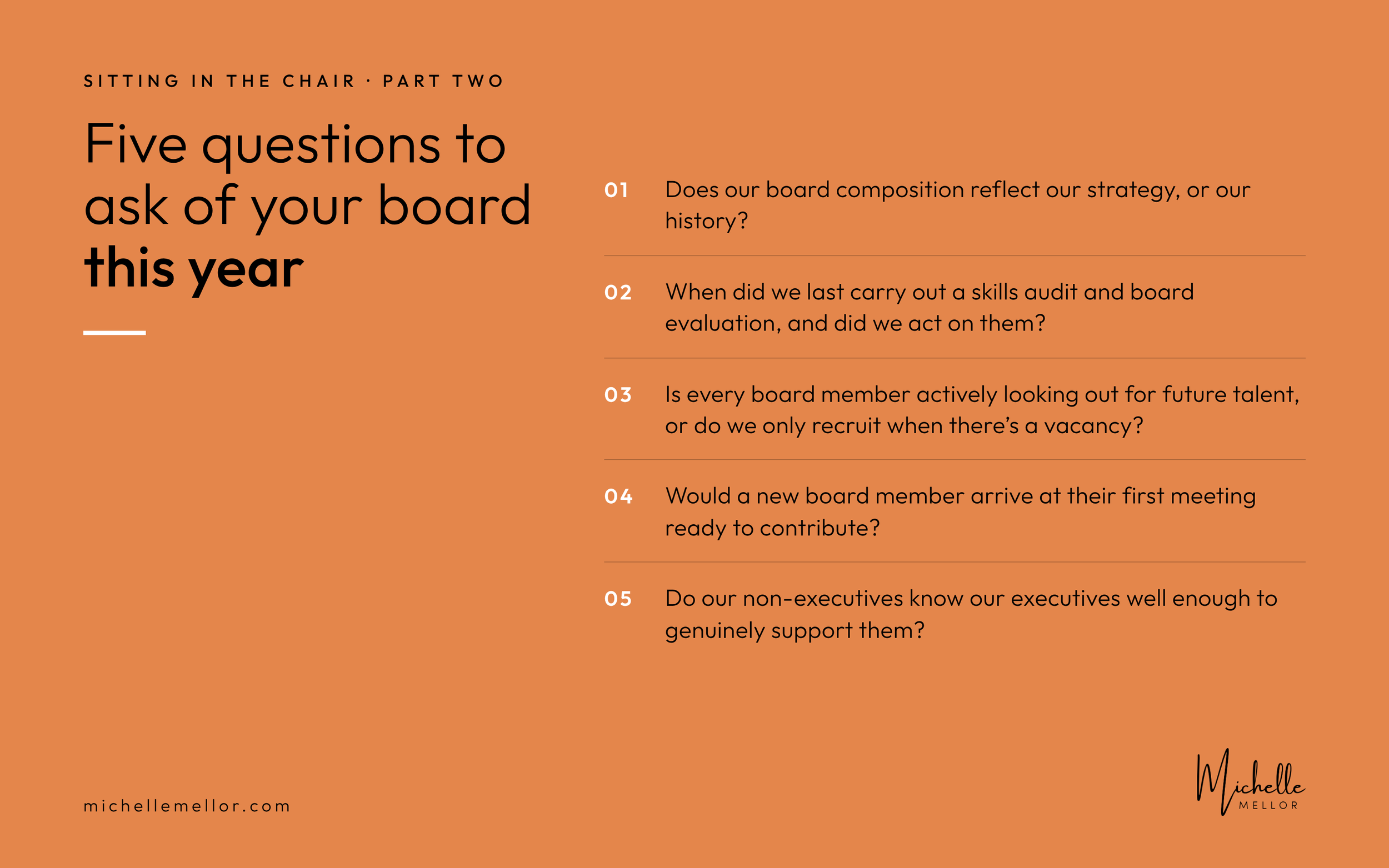
The question for the board table…
“If you were building your board from scratch today, would you choose the board you have now? And when did each of you last say to someone you know…Have you ever thought about joining a board? "
If you're a Chair or a board working through the gap between the board you have and the board you need, and would like to talk it through. You can find me at michellemellor.com or connect with me on LinkedIn.
Next in the series: getting the right people around the table is only the start. Next week, I’ll look at the most important relationship of all: the Chair and the CEO, and how to build the kind of trust that can carry a genuinely difficult conversation.