

Part three of “Sitting in the Chair” - the most important relationship.
In the first piece in this series, I described the Chair and CEO as the pilot and co-pilot of an aircraft. It's an image I want to come back to, because it captures this relationship better than anything else I know.
The CEO flies the plane day to day. The Chair sits alongside, watching the instruments, scanning the horizon and ready to take a share of the weight when the weather turns. Neither can do the other's job. But if the two aren't working as one, the board can't lead well and the organisation feels it.
That's why I believe the Chair–CEO relationship is the most important relationship in any organisation. It's also one of the hardest to get right. Get too close and you lose the ability to challenge. Stay too distant and you never earn the right to. So how do you build a relationship that can hold both trust and challenge?
Here's what I learned.
Trust isn't declared. It's built, week by week, in how you show up.
Whatever anyone tells you about the amount of time the Chair role needs, you can probably triple it.
Most people see the board meetings. Far fewer see everything around them: the conversations with individual board members, time with committee chairs to make sure the committees and the board are pulling in the same direction, work with the Advisory Council, and the ongoing job of building relationships with stakeholders across the sector and beyond. Much of a Chair's work is invisible, and almost all of it is about relationships.
With all of that competing for your time, it would be easy to let the CEO relationship become just another item in the diary. It mustn't. Despite every other demand, time with the CEO is the most important time a Chair spends.
Chair and CEO are often in different parts of the country, each busy with their own role, so time together is never as plentiful as you'd like. That makes availability one of the most valuable things a Chair can offer. Things don't arrive neatly at the board meeting. They come in from the side: an operational problem, a people issue, a reputational risk, or sometimes a difficult personal situation the CEO is carrying.
In every one of those moments, the Chair should be the one person the CEO can rely on to be there. Not only when things are going wrong, but when things are going well too. Being in the cockpit consistently is what builds the trust you'll need when the turbulence comes.
Build a rhythm: the weekly one-to-one
We met every week. It was the anchor of our working relationship. A Chair juggles many things: board members, committees, stakeholders. The weekly one-to-one was our chance to align, catch up on our respective roles, and look at how the business was tracking and how the people and team were.
Three things made those conversations work:

Strategy, not status. I focused on strategic alignment, removing high-level roadblocks and understanding the organisation's broader priorities, rather than getting bogged down in daily updates. That's the executive's territory.
Bring your own agenda. I always came with two or three specific topics, so the CEO wasn't carrying the whole conversation and the Chair's perspective had a place.
Prepare in advance. I'd note things I'd seen or wanted to discuss and send them ahead, so we used our time well.
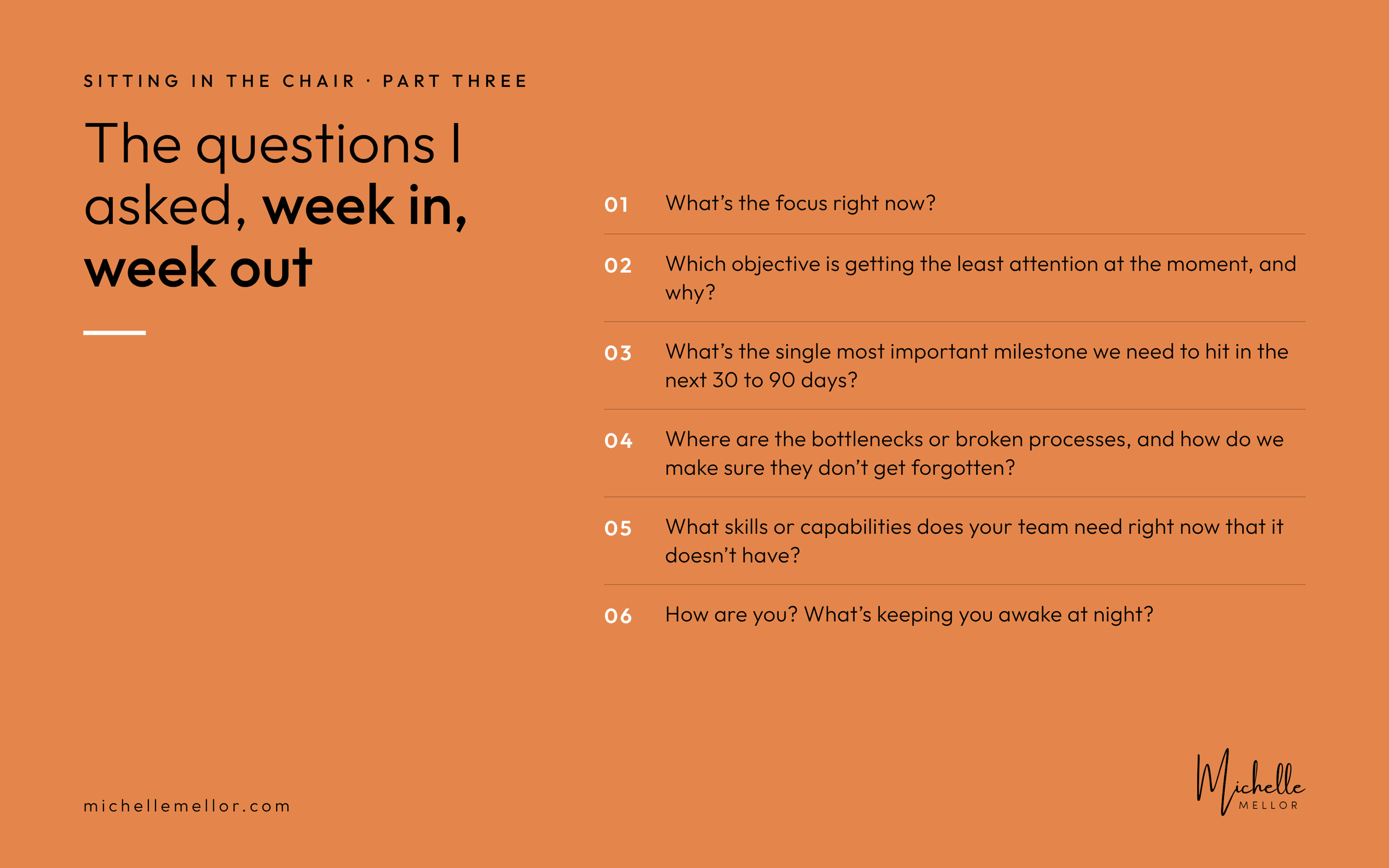
Look after the person, not just the role
That last question matters more than it might seem. I always asked how the CEO was. Were they sleeping? Seeing their family? Looking after themselves? Leading an organisation can be lonely, and the CEO is often the person everyone else turns to, with no one checking on them. I also made a point of saying "well done" and "good job". Ask yourself: who else tells the CEO they're doing well? The team reports to them, and the board holds them to account. Recognition from the Chair, given sincerely and specifically, is rarer and more valuable than most people realise.Keep your word and keep it honest

Trust is built in small moments, and most of them come down to doing what you said you'd do. If I offered to meet the team, give a presentation or speak to the whole organisation, I showed up. Every time. I made myself available to the wider executive team, not just the CEO, and sent notes of congratulations or recognition when something had gone well. I made a point of being seen in the office, saying hello to people and asking how they were. I also encoraged board members to attend staff huddles and to be present in the office too. A board that shows up at team events, in conversations, in everyday, sends a powerful message: we see you, and what you do matters- it turns startegy from words on a page into a shared purpose. It also gives the board something no report ever can: a real feel for the organisation they serve. None of these things are big on there own. Together, they show the CEO, and the organisation, that the Chair and the board are invested, reliable and on their side. Trust only matters if it can carry the truth.
These are the habits that keep the relationship candid. A strong Chair–CEO relationship has to hold up under outside pressure: from the board, from stakeholders and from events
Step out of the business to see the bigger picture

Weekly conversations keep you aligned week by week. But every so often, you need to lift your eyes to the horizon. After all, a Chairs role is to make sure the board is thinking ahead, horizon scanning for what’s coming and a clesr sense of where we are heading.
At performance review time, we'd take ourselves out of the business entirely and go walking. Away from the office, the screens and the next meeting, we'd talk through the CEO's performance and ambitions: where they were heading, how the plans for the year were tracking against the strategy, and how all of it fitted with the organisation's bigger goals.
Walking side by side changes the conversation. It's less formal than sitting across a table, and it leaves more room for honesty and reflection, about the organisation and about the CEO's own development.
A performance review shouldn't feel like an exam. It should feel like two leaders taking stock of the journey together.
Ask for feedback, and expect challenge back
If you expect honesty from your CEO, you have to invite it about yourself. I regularly asked the CEO how I was doing as Chair: what was helpful, what support looked like and what I could do better. The answer always came back to the same thing. What mattered most was the challenge. A CEO doesn't need a cheerleader in the Chair. They need someone who will ask the hard question, test the thinking and push them and the business to be better, from a place of trust. Asking the question also models the openness you want from the whole board. A Chair who invites feedback makes it safe for everyone else to give it.
No surprises, in either direction
The principle I held to most firmly was this: the conversation happens with the CEO first, never for the first time in a board meeting. The weekly one-to-ones made that possible. Honest accounts of what was going well and what wasn't flowed both ways, so neither of us was ever caught off guard in front of the board.
We also planned every board meeting together. I'd be clear about what I wanted on the agenda, and we would agree what the CEO and executive needed from the board. We'd talk the meeting through beforehand, so nobody walked in cold. In the meeting, I always made clear what was for decision and what was for discussion, and took the decisions first. And where the board had its own priorities on an item, I made sure they were brought into the open when we were all together, rather than left in the corridor.
The same goes for the papers. Board papers should make it simple to see what's a priority, what's risky, and where the numbers and the people are. Clarity in the papers leads to clarity in the conversation.
Be the bridge between the board and the CEO

The Chair carries the board's views to the CEO, and the CEO's views to the board. Done well, both sides feel heard and nobody feels bypassed. That also means protecting the relationship from well-meaning interference. Board members are capable, experienced people, and it's natural for them to want to help. But when individual board members go directly to executives, or drift into operational detail, the lines of accountability blur and the CEO's authority is undermined. Part of the Chair's role is to channel that energy constructively, through the board, its committees and initiatives like board sponsor projects, so that support for the executive strengthens the CEO rather than working around them.
Speak with one voice
To members, stakeholders, partners and the media, the Chair and CEO must be aligned. You may debate hard in private, and you should. But once a position is agreed, the organisation should never hear two different messages from its two most senior leaders. Agreeing in advance who speaks on what, and making sure each of you knows what the other is saying, protects the organisation's reputation and the relationship itself.
Hold steady when the pressure is on
Every Chair and CEO will face difficult moments together: a crisis, a setback, a decision with no easy answer. That's when the relationship is truly tested, and when all the groundwork pays off. The weekly conversations, the kept promises and the no-surprises habit mean that when pressure arrives, you aren't starting from scratch. You already know how the other thinks, you trust each other's judgement, and you can move quickly and calmly. The cockpit is no place to be getting to know your co-pilot.
Know where the line is
The Chair's job is to support, challenge and hold to account. It isn't to run the organisation. The CEO flies the plane. In practice, that means asking rather than telling. A well-timed question lets the CEO find the answer and own it. When you disagree, and you will, have that conversation privately first, challenge the idea rather than the person, and once a way forward is agreed, stand behind it together. There will be moments when the Chair needs to step in: when the organisation's interests, its reputation or the board's responsibilities are genuinely at stake. Most of the time, though, the most valuable thing a Chair can do is step back, ask the next good question, and let the CEO lead.
Start as you mean to go on
If I were starting again, I'd be even more upfront from day one. Every new leadership relationship benefits from an honest early conversation: how you like to work, your style, the impact you hope to make, and where the Chair's role starts and ends. Setting that out at the beginning means you're not discovering each other's expectations at the worst possible moment. It's the foundation everything else is built on.
The question at the heart of it…
Can you have a genuinely difficult conversation and still maintain trust? In my experience, yes, but only if you've done the work before you need it. The weekly conversations, the kept promises, the "well done", the no-surprises habit. Trust is what makes difficult conversations possible. Without it, even small challenges feel like attacks. With it, the hardest conversations become part of how two leaders keep the organisation on course together.
The question for the board table…
If your Chair and CEO had to have a really difficult conversation tomorrow, is the trust already there to carry it?
Next in the series: Strategy isn’t a document. Most boards have signed off a strategy. Far fewer can say, hand on heart, whether it’s really being delivered. Next week I’ll look at how the board holds the executive to account for the plan without slipping into running it, and the one question that separates real progress from simply being busy.
If you're a Chair, a CEO or a board looking to strengthen this most important of relationships, I'd be glad to talk it through. You can find me at michellemellor.com or Linked In